What helps the change last after a psychedelic session
One theme ran through this issue's research: a session can open a door, and what happens in the weeks after it matters a great deal. Two alcohol studies, a ketamine review and an MDMA study all point the same way.
We also look at how your setting changes what psilocybin does in the brain, and at two policy moves that shape who can get this care.
New research
1
Psilocybin for alcohol use: a real early benefit that tends to fade
Journal of Psychopharmacology and Drug and Alcohol Dependence, October 2026
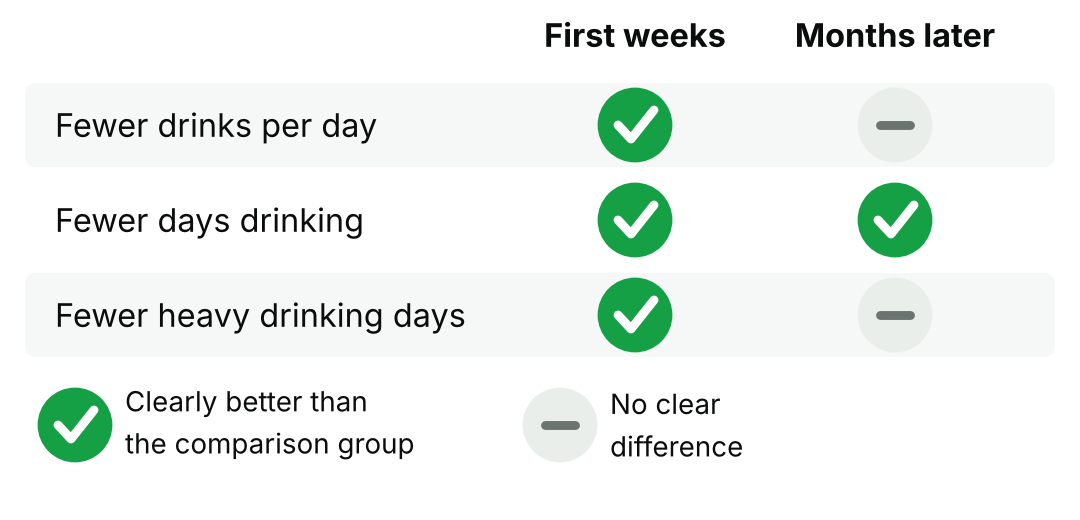
Did psilocybin beat the comparison group?Results pooled from 6 trials, 202 people. People who got psilocybin were also about 2.8 times as likely to stay abstinent.
What they did
One team pooled the results of six psilocybin trials for alcohol use disorder, covering 202 people. A second team gave 59 people from an earlier trial one more psilocybin session, with four hours of therapy, and followed them for four months.
What they found
Across the six trials, people who got psilocybin drank noticeably less than people in control groups in the first weeks. Four to 28 weeks later, only one measure, how many days people drank at all, was still clearly better. People who got psilocybin were also about 2.8 times as likely to stay abstinent. In the follow-up study, heavier drinkers cut back in the month after the extra session, then returned to where they started.
Why it matters
Both studies show the same pattern: psilocybin can bring a real early drop in drinking, and without more support much of that drop fades over the following months.
Keep in mind
Only three of the six trials had a randomized control group, and all were small. The follow-up study had no comparison group.
Ketamine plus mindfulness support kept more people off alcohol for months
medRxiv preprint, September 2026
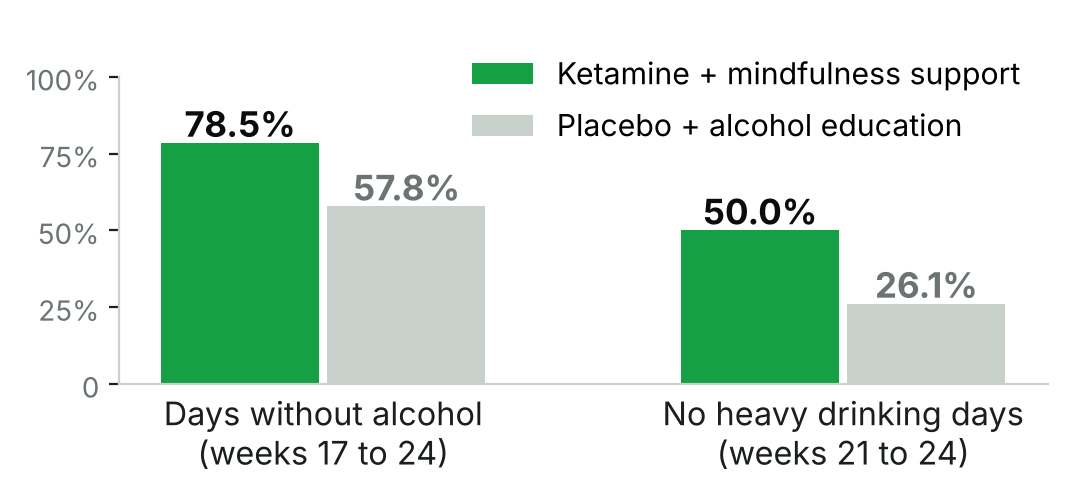
Ketamine plus support vs. placebo plus education4 to 6 months after a 3-week course of infusions ended. The no-heavy-drinking difference could have been chance.
What they did
In the KARE trial, 96 adults with severe alcohol use disorder who had just stopped drinking got three weekly infusions of ketamine or a placebo. Each person also got either mindfulness-based support or basic alcohol education. This new analysis compared the group that got ketamine with support to the group that got placebo with education.
What they found
Four to six months after the infusions ended, the ketamine-plus-support group went without alcohol on 78.5% of days, compared with 57.8% for the placebo-plus-education group. Half of the ketamine-plus-support group had no heavy drinking days in the last month, compared with about a quarter of the other group, though that difference could have been chance.
Why it matters
A short course of ketamine, paired with psychological support, was linked to benefits that lasted months after treatment stopped.
Keep in mind
The researchers chose these comparisons after the trial ended, looked at only two of the four groups, and the paper has not been peer reviewed yet.
Ketamine for depression: add-on pills didn't help, therapy might
Journal of Affective Disorders, October 2026
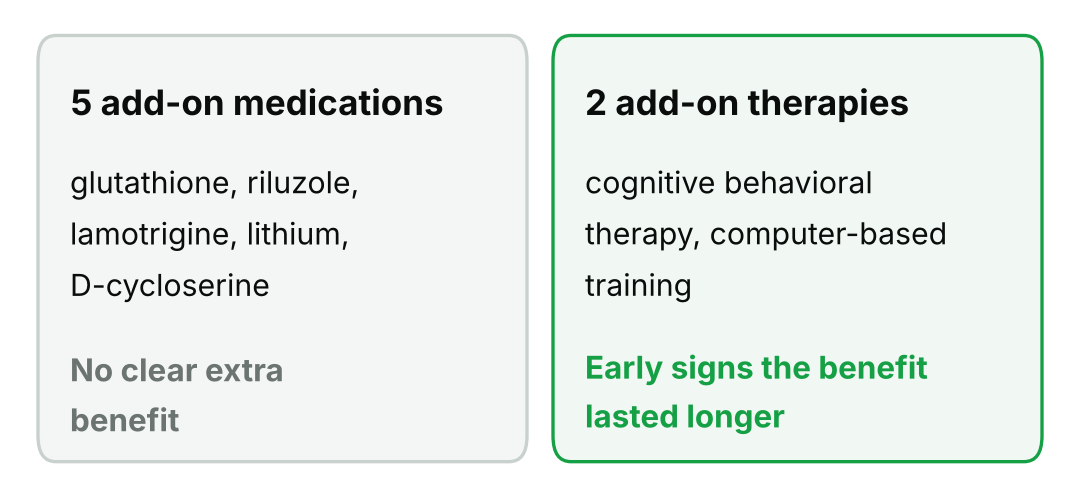
What was added to ketamine, and what it did7 trials, 346 people with hard-to-treat depression.
What they did
Researchers pooled seven randomized trials covering 346 people with depression that had not responded to other treatments. Everyone got IV ketamine. Some also got an add-on meant to make the benefit stronger or last longer: one of five medications, or one of two kinds of therapy.
What they found
Ketamine eased depression, as expected. None of the five add-on medications made a clear difference. The two therapy add-ons, cognitive behavioral therapy and a computer-based training program, showed early signs of helping the benefit last, though each was tested in only one trial.
Why it matters
Ketamine's benefits often fade within weeks. This review suggests that what people do between sessions may matter more for keeping those benefits than adding another drug.
Keep in mind
The trials were small and very different from one another, so the reviewers rated the evidence as low certainty.
MDMA-assisted therapy and learning to be kinder to yourself
PsyArXiv preprint, October 2026
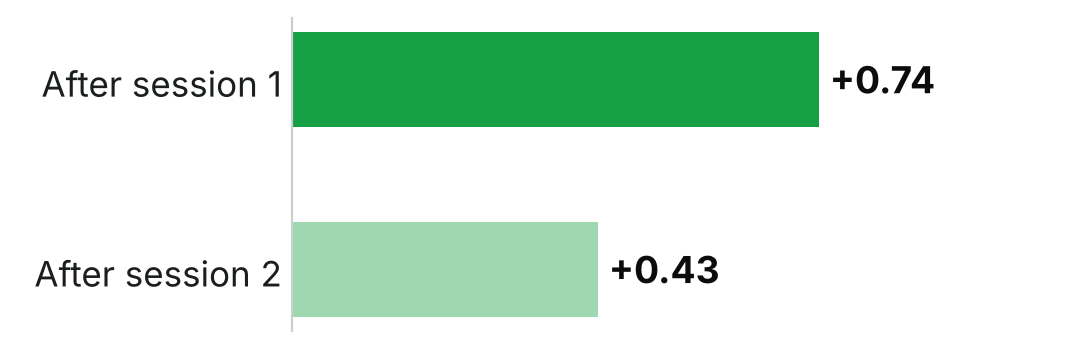
How much self-compassion grewAverage rise in self-compassion scores, 20 people with social anxiety.
What they did
Researchers followed 20 adults with social anxiety through 16 weeks of MDMA-assisted therapy, which included two MDMA sessions. They measured self-compassion, meaning how kindly people treat themselves, during the sessions and across treatment.
What they found
Self-compassion rose most after the first MDMA session and rose again, by a smaller amount, after the second. People who felt more self-compassion during their sessions had lower depression and shame at the end of treatment.
Why it matters
It points to one way a session may carry into daily life: a lasting shift in how people relate to themselves.
Keep in mind
Only 20 people, no comparison group, and the paper has not been peer reviewed yet.
Your setting changes how psilocybin affects the brain
bioRxiv preprint, October 2026
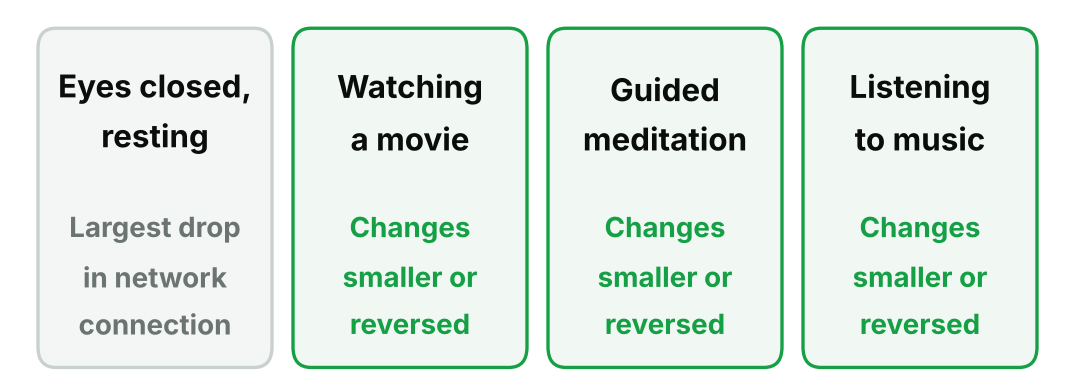
Same dose, four settingsBrain recordings from 56 people on psilocybin.
What they did
Researchers recorded brain waves (EEG) from 56 people before and after they took psilocybin, the largest study of its kind so far. They recorded in four settings: resting with eyes closed, watching a movie, following a guided meditation, and listening to music.
What they found
At rest with eyes closed, psilocybin changed the brain's rhythms and weakened communication between brain networks involved in attention and control. While people were watching, listening or following a meditation, those communication changes were smaller, and some went the other way.
Why it matters
What surrounds a session, from music to guidance, appears to shape what happens in the brain, not just how the experience feels.
Keep in mind
Everyone knew they were taking psilocybin, there was no placebo session, and the settings were not in a random order.
Psychedelic Alpha and the Institute for Clinical and Economic Review (ICER), October 2026
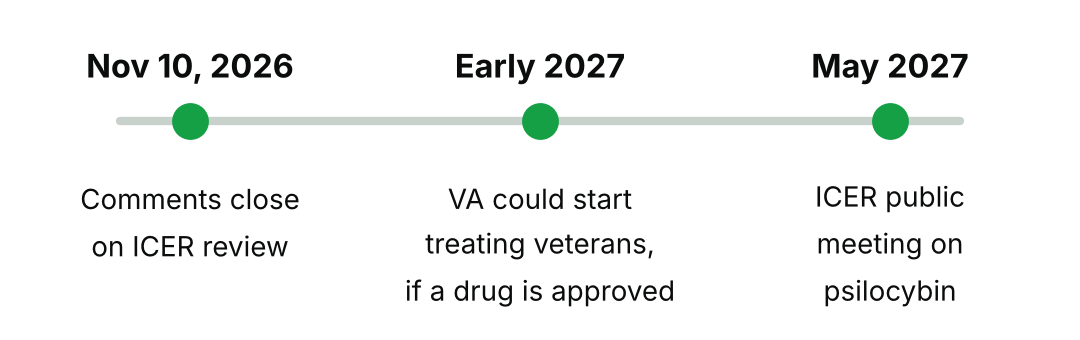
What's comingDates announced so far.
The VA picked its first ten sites. A senior Veterans Health Administration advisor said the VA has chosen ten first sites, not yet named, and could begin treating veterans as soon as an approved treatment becomes available, possibly in early 2027. The VA expects demand to outpace supply and plans to collect real-world data as it goes.
An independent group will weigh the cost of psilocybin for depression. ICER, a nonprofit whose reviews insurers often consult, has started reviewing a psilocybin treatment for depression that hasn't responded to other options. Public comments are open until November 10, and a public meeting is planned for May 2027.
Why it matters
The largest health system in the US is preparing to offer this care and track how people do over time, and reviews like ICER's help decide whether insurance covers it.
New psychedelic research in plain language, every two weeks.
This digest is put together by the Psio team, led by founder Devin Effinger, PhD, a neuroscientist who specializes in psychedelics.
This digest is for general education. It is not medical advice, and nothing in it recommends using any substance. Psychedelics remain illegal in most places outside licensed or approved programs.