Most of this issue is about the stretch after a session. Two studies look at what people go through in the days and weeks that follow, and neither found a straight line. Mood can dip even when things are improving on average. That's worth planning for.
We also look at an updated review of MDMA-assisted therapy for PTSD and a small trial of how psilocybin changed the way people quitting alcohol take someone else's point of view. Under policy, the FDA asks how ibogaine trials should be run, and researchers put Oregon's psilocybin centers to an undercover test.
New research
1
On nasal esketamine, suicidal thoughts eased on average but rose at times for some people
Journal of Affective Disorders, October 2026
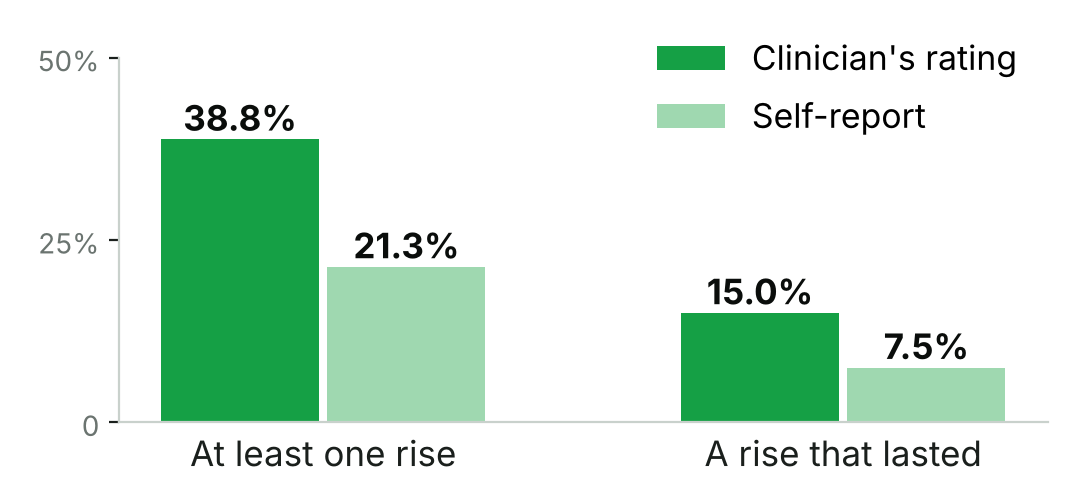
How many people had a rise in suicidal thoughts80 people treated with nasal ketamine or esketamine. On average, ratings went down. Rises were measured from one visit to the next.
What they did
Researchers in Zurich went back through the records of 80 people treated with nasal ketamine or esketamine for depression that had not responded to other treatments. They tracked how ratings of suicidal thoughts moved from one visit to the next across the whole course.
What they found
On average, the ratings went down a little. But rises and falls between visits were about equally common: 38.8% of people had at least one rise on the clinician's rating, and 15.0% had a rise that lasted. People who started with higher ratings were the most likely to get worse later, and there were two serious adverse events, one of them a suicide.
Why it matters
The rises didn't cluster at any one stage of treatment, so the authors conclude that suicidal thoughts should be checked at every visit, not only at the start.
Keep in mind
This was a look back at routine care records with no comparison group, so it cannot say whether the treatment caused the rises.
Most people who had used MDMA reported a rough stretch afterward, starting about a day later
Psychopharmacology, October 2026
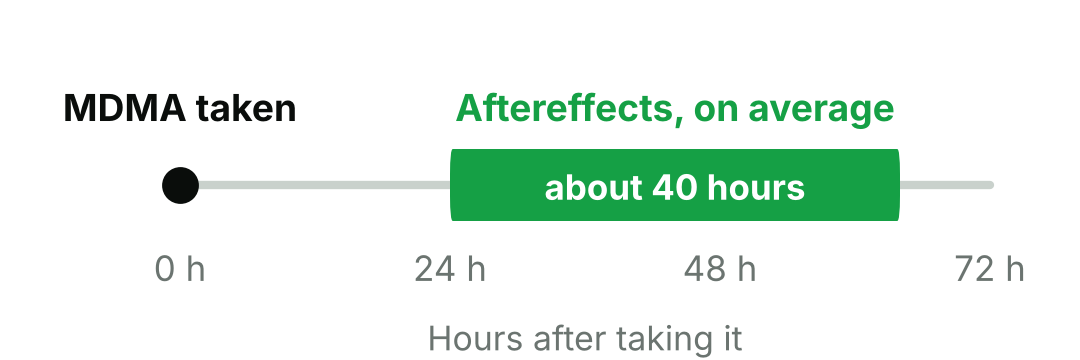
When the aftereffects came497 adults who had used MDMA recreationally, describing their own past experiences.
What they did
Researchers surveyed 497 adults online who had used MDMA recreationally, asking what they had felt in the days after.
What they found
74.5% said they'd had a period of feeling worse afterward at least once. It usually started about a day later and lasted about 40 hours on average, with fatigue (88.1%), trouble concentrating (85.7%) and restlessness (82.9%) the most common symptoms. Among people who'd had these aftereffects, 14.6% reported passive suicidal thoughts and 6.2% active ones.
Why it matters
For anyone supporting someone after an MDMA session, the second and third days may matter more than the evening of the session itself.
Keep in mind
These were recreational users recalling past experiences in an online survey, so the numbers may not carry over to screened people in a therapy setting.
MDMA-assisted therapy eased PTSD in the short term across six trials, all from one sponsor
Neuropsychopharmacology, October 2026
What they did
Researchers pooled six randomized trials of MDMA-assisted therapy for PTSD, covering 286 people, in which chance decided who got MDMA and who got a comparison treatment. It is a living review, meaning the team will add new trials as they come out, and the data are open for anyone to check.
What they found
People who got MDMA-assisted therapy had larger drops in PTSD symptoms than the comparison groups. Compared with placebo, they were about a third more likely to respond to treatment and about 2.25 times as likely to reach remission, the point where symptoms have largely cleared.
Why it matters
Because the dataset is open and updates as new trials come in, anyone can check whether this benefit holds once groups outside MAPS report their results.
Keep in mind
All six trials were sponsored by MAPS, and the reviewers rated the evidence as low certainty, partly because people can often tell whether they got MDMA, which can shape how they report their symptoms.
After psilocybin, people quitting alcohol were less stuck in their own point of view
medRxiv preprint, September 2026
What they did
In a small trial in France, 30 people who had recently been through alcohol detox and still had symptoms of depression were randomly assigned to a full dose of psilocybin or a very low dose used as an active placebo (a dummy that has slight effects, so people are less sure which group they are in). Before the session and three weeks after, they did a computer task that measures how much your own view gets in the way when you judge what someone else can see.
What they found
Three weeks after the session, people in the full-dose group were less slowed down by their own point of view than before, and the change was larger than in the low-dose group. How well they took in the other person's view didn't change, and neither did their accuracy. People who reported a more intense experience showed less of this self-centered pull on one of the measures.
Why it matters
It is a specific, measurable shift in how people relate to others, still there three weeks after a single session.
Keep in mind
Only 24 people were analyzed, just 6 of them in the low-dose group, and the paper hasn't been peer reviewed yet.
The FDA asks how to test ibogaine, and Oregon's centers pass a spot check
FDA and Health Affairs Scholar, October 2026
The FDA wants input on early ibogaine trials. On October 5 the agency asked the public how first trials of ibogaine should be designed, including who should take part, how to watch for heart and nervous system problems, and who oversees safety. It cites serious safety concerns alongside open scientific questions. Federal research is focusing on adults with opioid use disorder and PTSD, and comments are open until November 20.
Oregon's psilocybin centers followed the screening rules in an undercover check. Researchers at Washington University in St. Louis called Oregon's 22 active centers posing as would-be clients with depression plus alcohol use disorder or a family history of psychosis, and reached 15. All of them followed the state's screening rules and none allowed take-home use, but the median session cost $1,900 and none took insurance.
Why it matters
How the FDA sets up ibogaine trials will decide whether it can be tested safely, and Oregon shows a licensed program can screen people carefully while price still keeps many of them out.
New psychedelic research in plain language, every two weeks.
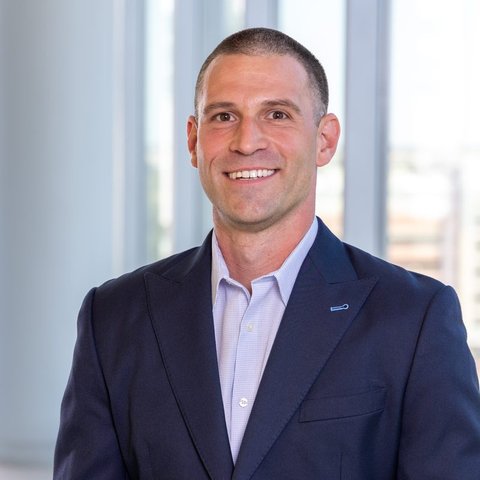
This digest is put together by the Psio team, led by founder Devin Effinger, PhD, a neuroscientist who specializes in psychedelics.
This digest is for general education. It is not medical advice, and nothing in it recommends using any substance. Psychedelics remain illegal in most places outside licensed or approved programs.