The thread this week is what happens after the medicine. In a small trial from Taiwan, people whose depression lifted after two ketamine infusions then got five days of magnetic brain stimulation or a sham version, and the real stimulation kept their depression scores lower for the next seven weeks. Ketamine's benefit often fades within days. Anything that helps it hold is worth a close look.
We also look at a trial of MDMA-assisted therapy for social anxiety that wrapped two MDMA sessions in nine sessions of preparation and integration, and at a panel of ketamine experts who could agree on only a third of the questions clinics face. Under policy, the federal government put money behind ibogaine and behind a new research network for fast-acting treatments like ketamine and psilocybin.
New research
1
Five days of brain stimulation after ketamine kept depression scores lower for weeks
Psychiatry and Clinical Neurosciences, November 2026
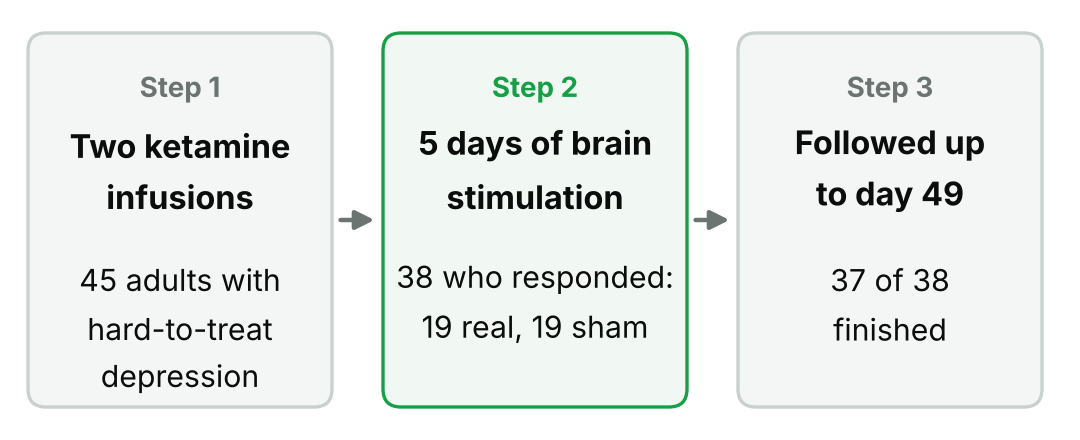
How the trial workedOnly people whose depression improved after ketamine went on to step 2. Sham stimulation mimics the real procedure without stimulating the brain.
What they did
In Taiwan, adults with hard-to-treat depression whose mood improved after two low-dose ketamine infusions were randomly assigned to 5 days of accelerated intermittent theta-burst stimulation (iTBS, a fast form of magnetic brain stimulation) or a sham version. It was double-blind, and 38 people took part, 19 in each group.
What they found
Across the seven weeks of follow-up, people who got real stimulation had lower depression scores, and more of them were in remission at days 15 and 29. They also tended to keep their response longer, though that difference fell just short of the trial's bar for a clear result. Brain scans in 15 people suggested the stimulation changed connections between deeper brain hubs and the cortex.
Why it matters
Ketamine's lift often fades within days, so a short follow-up treatment that helps it hold would change how a course of care is planned.
Keep in mind
Only 38 people took part, all had already responded to ketamine, and follow-up ended at day 49.
MDMA-assisted therapy cut social anxiety in a small randomized trial
Journal of Affective Disorders, November 2026
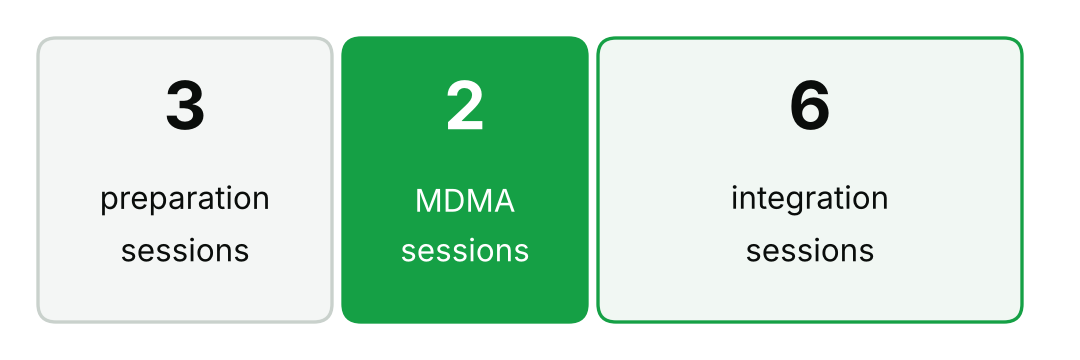
What the treatment includedEach preparation and integration session lasted 90 minutes.
What they did
At the Portland Institute for Psychedelic Science, 20 adults with social anxiety disorder were randomly assigned to start MDMA-assisted therapy right away or after a 16-week wait. Treatment was three 90-minute preparation sessions, two MDMA sessions and six 90-minute integration sessions.
What they found
At 16 weeks, scores on a standard social anxiety scale were 43.3 points lower on average in the treated group than in the group still waiting, day-to-day functioning improved, and there were no serious adverse events. In a separate paper posted this week (a preprint, not yet peer reviewed), the same 20 people described what helped: facing hard feelings gently, feeling safe, and trying new ways of relating to others.
Why it matters
People described the safety of the therapy setting as part of what helped, a reminder that the hours before and after a session are part of the treatment.
Keep in mind
Everyone knew who was being treated and the comparison was a wait, not a placebo, so hope and expectation could explain part of the gap.
Ketamine experts agreed on only a third of the questions clinics face
Journal of Clinical Psychiatry, November 2026
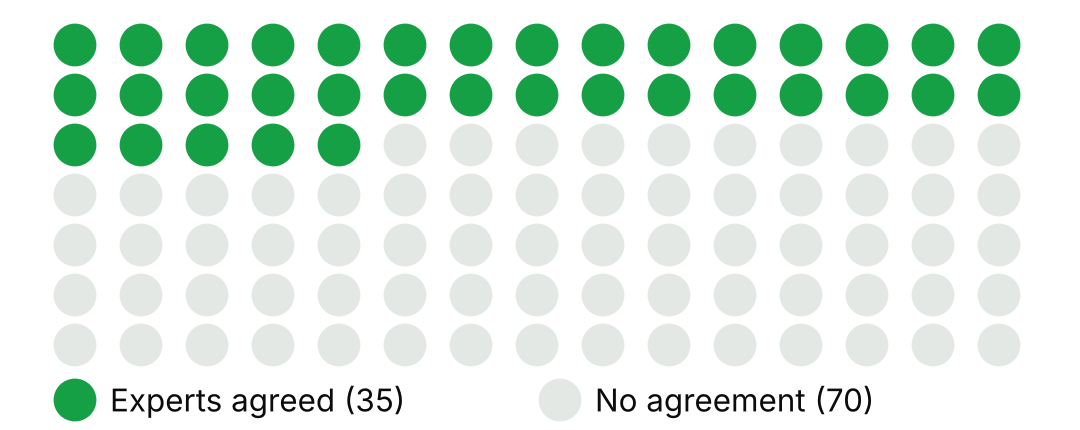
How many of 105 questions the experts agreed onAgreement meant at least 75% of the 21 panelists landed on the same side.
What they did
The American Society of Clinical Psychopharmacology asked 21 psychiatrists who treat and study mood disorders with ketamine and esketamine to rate 105 statements about real-world care. They used two rounds of a Delphi survey, a structured way of polling experts until their views settle.
What they found
The panel agreed on 35 of the 105 (33%), in areas such as which conditions to treat, who shouldn't get ketamine, maximum doses and safety monitoring. Open questions included oral and injected forms, high-dose infusions, ketamine-assisted psychotherapy, and use for conditions other than major depression.
Why it matters
Ketamine care has spread faster than the trials behind it, so clinics, therapists and patients are often making choices the evidence hasn't settled.
Keep in mind
This is the opinion of 21 academic psychiatrists, not new data on how patients did.
New federal money for ibogaine and for research on fast-acting treatments
U.S. Department of Health and Human Services, November 12, 2026
Ibogaine gets early-stage funding. On November 12, HHS said ARPA-H, its advanced research agency, will commit up to $4.9 million over five years to groundwork for ibogaine as a possible treatment for PTSD, including in veterans. Teams led by Mark Cuban Cost Plus Drug Company will prepare for future US trials and domestic manufacturing. The awards don't pay for treatment or human studies, and HHS noted ibogaine's risk of dangerous heart rhythm problems.
A $20 million network for fast-acting treatments. In the same announcement, HHS described a National Institute of Mental Health funding call for a research network on rapid-acting treatments such as ketamine, esketamine and psilocybin, starting with a data center that pools results from real-world care. Its priorities include add-on treatments and how often to repeat treatment. The money is split into $10 million this fiscal year and $10 million next, with awards expected in summer 2027.
Why it matters
Much of ketamine care happens in ordinary clinics with little shared data, and a network built to collect it could start answering the questions the expert panel above couldn't settle.
New psychedelic research in plain language, every week.
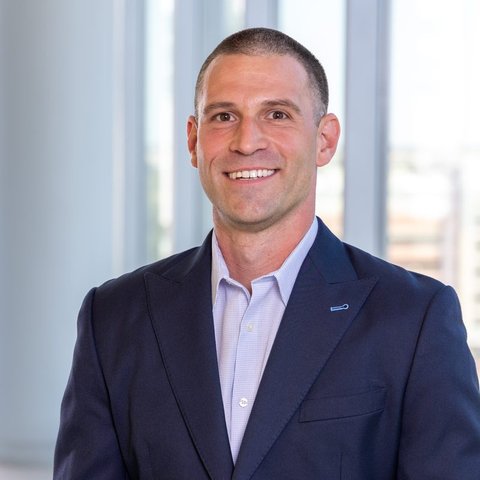
This digest is put together by the Psio team, led by founder Devin Effinger, PhD, a neuroscientist who specializes in psychedelics.
This digest is for general education. It is not medical advice, and nothing in it recommends using any substance. Psychedelics remain illegal in most places outside licensed or approved programs.