The most hopeful thread this time is about the session itself getting shorter. In a trial of 193 people, one nasal dose of a fast-acting psychedelic eased hard-to-treat depression for two months, and most people were ready to go home within two hours. That changes who can offer this care, and it makes the weeks after the clinic matter even more.
We also look at a brain scan study that tested a popular idea about how psilocybin works and didn't find it, what a psychedelic support line has learned from 25,419 conversations, and what people with lasting problems after psychedelic use went through when they looked for help. Under policy, both psilocybin applications are now at the FDA.
New research
1
One short dose of a fast-acting psychedelic eased hard-to-treat depression for two months
JAMA, October 2026
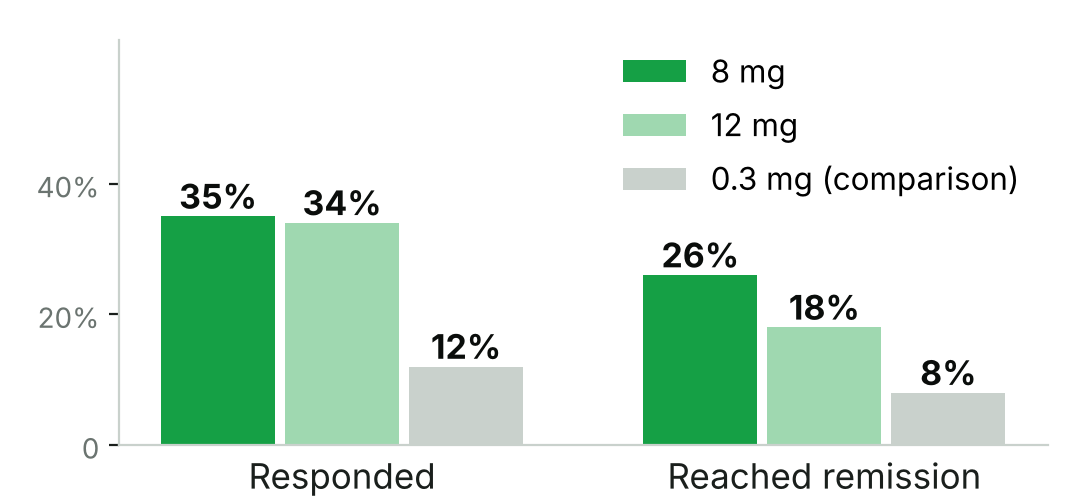
How many people improved, four weeks after one dose193 people whose depression had not responded to 2 to 5 antidepressants. Remission means symptoms had largely cleared.
What they did
At 38 sites in Australia, Europe and the US, 193 adults whose depression had not responded to 2 to 5 antidepressants were randomly assigned to one nasal dose of mebufotenin (5-MeO-DMT) at 8 mg or 12 mg, or a 0.3 mg comparison dose, all with psychological support. It was double-blind: neither the people nor the staff rating them knew who got which dose.
What they found
Four weeks later, depression scores had dropped further on both real doses than on the comparison dose, and the gap held at every check through day 57. About a third of people on either real dose responded (35% and 34%), compared with 12% on the comparison dose. Most were judged ready to leave the clinic within two hours: 85% on 8 mg and 78% on 12 mg.
Why it matters
A psychedelic session that fits in a couple of hours could be offered in many more clinics, which puts more weight on the support people get after they go home.
Keep in mind
Follow-up lasted only 8 weeks, and a full dose is hard to mistake for 0.3 mg, so many people likely knew which group they were in.
Psilocybin eased depression, but brain scans showed no rise in synapses
medRxiv preprint, November 2026
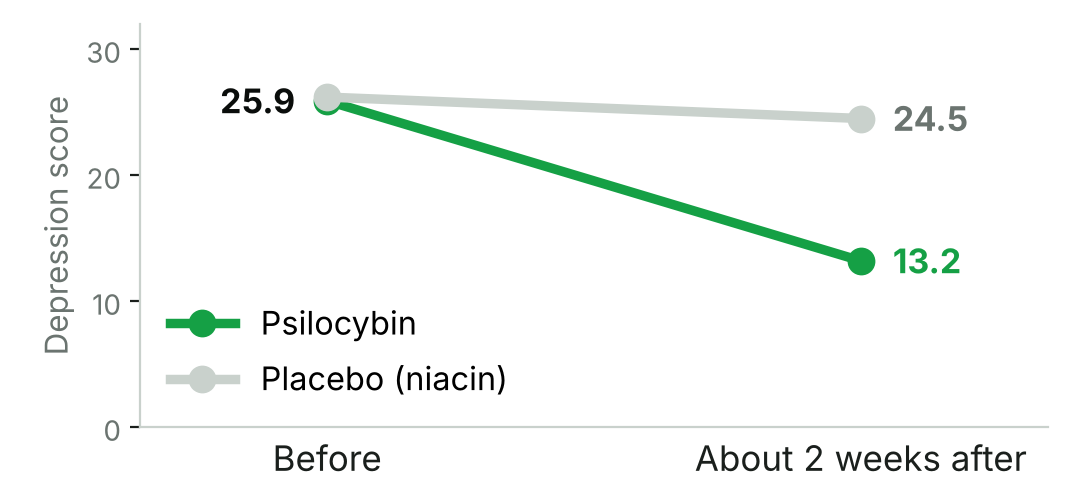
Depression scores before and after one session35 adults with recurrent depression in Stockholm, given psilocybin or a niacin placebo, both with therapy support. Lower scores mean less depression.
What they did
Researchers in Stockholm randomly assigned 35 adults with recurrent depression to one dose of psilocybin or to niacin as a placebo, both with therapy support. They used PET scans, which follow a tracer through the brain, to measure synapse density (how many connections there are between nerve cells) before the session and about two weeks after.
What they found
Depression scores in the psilocybin group fell from 25.9 to 13.2 on average, compared with 26.2 to 24.5 on placebo. But the scans showed no rise in synapse density in the hippocampus or the frontal cortex compared with placebo. People who started with higher synapse density tended to improve more.
Why it matters
In animals, psychedelics reshape synapses within a day, and many expected that to explain how they help; in these people the benefit came without it, at least two weeks out.
Keep in mind
There was only one scan after treatment, the group was small, and the paper hasn't been peer reviewed yet.
Five years of calls to a psychedelic support line are now open for research
Science Advances, October 2026
What they did
Fireside Project's Psychedelic Support Line is staffed by trained volunteers who talk with people during or after a psychedelic experience. The team released records of 25,419 conversations handled by 220 volunteers from April 2021 to February 2026, plus 2,777 caller surveys about how the conversation went.
What they found
Psilocybin was the substance named most often, in 59.9% of the conversations that were coded. Cannabis came with the highest rate of distress, at 47.2%. Because 50 volunteers each have at least 10 surveyed conversations, researchers can now test whether some supporters help callers more than others, and why.
Why it matters
Most psychedelic use happens outside clinics, and until now there was no systematic data on who reaches out for support or what makes that support work, which is what training for facilitators and peer supporters needs.
Keep in mind
These are people who chose to contact one US line, and only some of them filled in a survey, so they may not speak for everyone who has a hard time.
People with lasting problems after psychedelic use struggled to find help
Journal of Psychopharmacology, November 2026
What they did
Researchers interviewed 13 adults whose psychological symptoms persisted after using a classic psychedelic outside any clinic or study. Ten had lasting visual changes (hallucinogen persisting perception disorder, or HPPD) and six felt cut off from themselves or their surroundings (depersonalization or derealization); some had both.
What they found
Many said glowing accounts in the media and in science had shaped their choice to use, and then made it harder to see that something had gone wrong. Stigma, silence and self-blame kept them from asking for help. The authors note that few medical services are set up to treat these problems.
Why it matters
Saying plainly before a session that lasting problems can happen, and knowing where to refer someone if they do, may make it easier for people to speak up early.
Keep in mind
Thirteen people is a small group, all of them used psychedelics outside a clinic, and the study says nothing about how often these problems occur.
Psychedelic Alpha and Compass Pathways, November 2026
Usona has reportedly filed for approval in depression. Psychedelic Alpha reported on November 2 that the Usona Institute, a nonprofit, has completed its new drug application, the formal request for FDA approval, for psilocybin in major depressive disorder. Usona declined to comment. It holds a priority voucher that aims for a decision within about two months, and it is reportedly working with the FDA on the safety rules that would govern how the drug is given.
Compass filed for treatment-resistant depression. On November 9, Compass Pathways said it had completed its application for psilocybin in treatment-resistant depression, backed by two phase 3 trials and a phase 2b study with more than 1,000 people in all (company-reported). It also holds a priority voucher and is aiming to launch in the first half of 2027, if the FDA approves it and the DEA reschedules psilocybin.
Why it matters
If either is approved, psilocybin therapy would move beyond state programs and trials into regular medical care in the US. When that happens, and at what price, is still open.
New psychedelic research in plain language, every week.
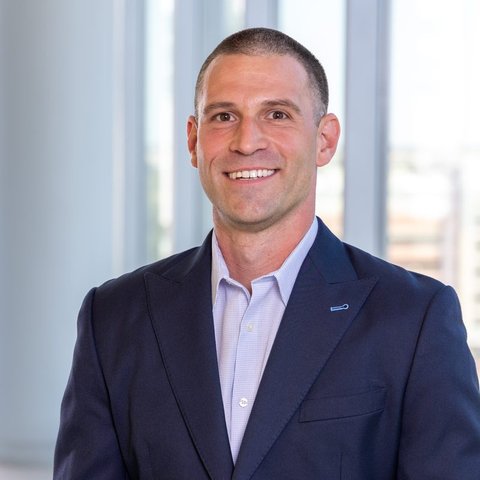
This digest is put together by the Psio team, led by founder Devin Effinger, PhD, a neuroscientist who specializes in psychedelics.
This digest is for general education. It is not medical advice, and nothing in it recommends using any substance. Psychedelics remain illegal in most places outside licensed or approved programs.