The thread this week is what keeps a good result going. In Toronto, 36 people whose bipolar depression had eased with ketamine kept getting booster infusions for 12 weeks, and by the end more of them were responding and far fewer had suicidal thoughts. There was no comparison group, so it's a first look. Still, this kind of follow-up care is what decides whether a good week turns into a good year.
We also look at a placebo-controlled trial that recorded sleep brain waves at home for a week after psilocybin, a study showing that what people write in their own words after a psychedelic experience helps predict how they fare, and a cohort of 1,940 young Swiss men that links first psychedelic use with less heavy drinking four years later. Under policy, the DEA proposed letting far more MDMA and ibogaine be made for research, and a House panel asked whether the VA will be ready if approvals come.
New research
1
Ketamine boosters kept bipolar depression easing for 12 more weeks
Med, November 2026
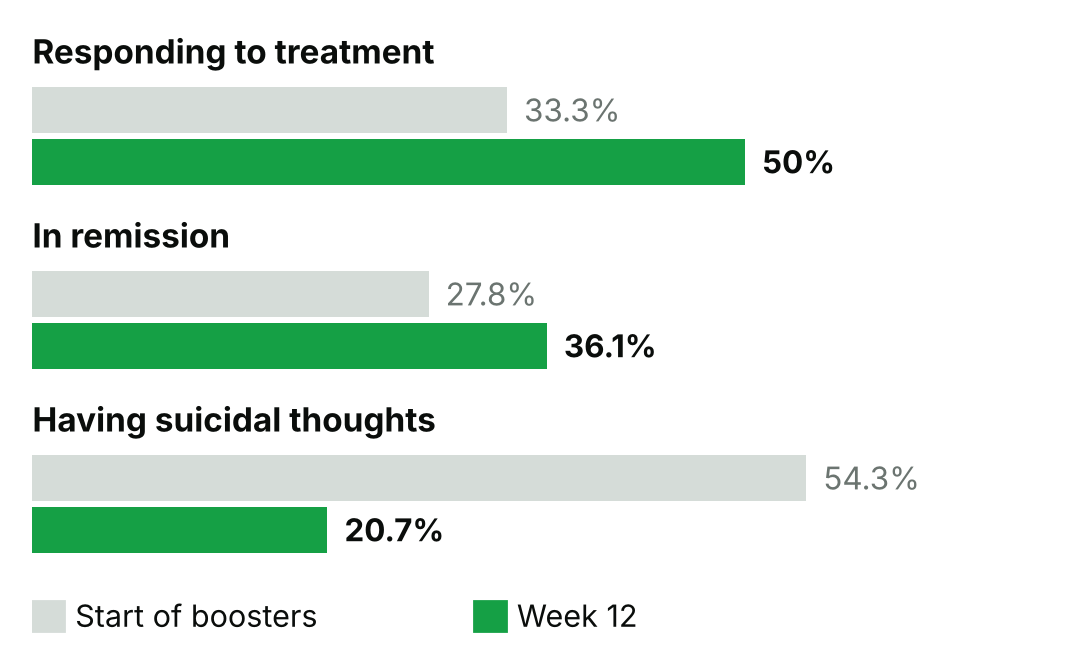
Before and after 12 weeks of booster infusions36 people with hard-to-treat bipolar depression who had already improved on a first course of ketamine. Percent of participants at each point.
What they did
At the University Health Network in Toronto, 36 adults with bipolar depression that hadn't responded to other treatments, and who had improved during a first course of IV ketamine, went on to a 12-week maintenance phase. They got up to six booster infusions, with the dose adjusted for each person, and had 5.14 on average.
What they found
Average depression scores on a standard clinician-rated scale fell from 19.8 to 15.6 over the 12 weeks. The share of people responding to treatment rose from 33.3% to 50%, and the share with suicidal thoughts fell from 54.3% to 20.7%. Nobody developed mania or psychosis during the boosters.
Why it matters
Relapse after a first course of ketamine is common, and this is early trial evidence that spaced boosters can help in bipolar depression, where maintenance ketamine has barely been studied.
Keep in mind
There was no comparison group and everyone knew they were getting ketamine, so the trial can't show how much of the gain the boosters caused.
After psilocybin, sleep brain waves kept changing for days
Research Square preprint, November 2026
What they did
At Johns Hopkins, in a placebo-controlled trial of psilocybin-assisted therapy for people with both depression and alcohol use disorder, 40 participants (22 on psilocybin, 18 on placebo) recorded their brain waves (EEG) at home while they slept, for three nights before the session and up to seven after.
What they found
After psilocybin, sleep efficiency (the share of time in bed spent asleep) and total sleep time went up for a few nights, then drifted back. The clearest change was in dream (REM) sleep, where faster brain rhythms rose and peaked about three nights after the session. The overall structure of sleep, such as time spent in each stage, stayed largely the same.
Why it matters
The biggest changes came days after the session, which fits the idea that the week afterward is an active period, and recording sleep at home is a simple way to watch it.
Keep in mind
No sleep measure tracked changes in drinking, a link with mood rested on only 14 people, and the paper hasn't been peer reviewed.
People's own words about a psychedelic experience helped predict how they fared
PsyArXiv preprint, November 2026
What they did
Researchers took three datasets on psychedelic experiences, with 229 to 958 people each, and used open-weight language models to turn people's written descriptions into numbers. They tested whether adding those numbers to 20 to 45 standard predictors (background, setting and questionnaire scores) improved predictions of five mental health outcomes for people the models hadn't seen.
What they found
For changes in well-being and in psychological flexibility (staying with hard thoughts while still acting on what matters), and for post-traumatic stress symptoms, the free text explained 3 to 10 percentage points more of the differences between people. That was a gain of 8% to 32% over the standard predictors. It didn't help for current well-being or for growth after trauma.
Why it matters
Open questions pick up something checkbox scales miss, so asking people to describe a session in their own words is worth doing and worth keeping.
Keep in mind
The gains were modest, they were tested within the same three datasets, and the paper hasn't been peer reviewed.
Young men who first tried psychedelics were less likely to keep drinking heavily
BMJ Open, November 2026
What they did
A nationwide Swiss study follows young men from army recruitment screening. This analysis took 1,940 who drank at unhealthy levels at 20 (more than 21 drinks a week, or 6 or more at once at least monthly) and had never used a psychedelic, and compared the 74 (3.8%) who first used one at 21 with the rest.
What they found
At 25, 58.8% of the whole group still drank at unhealthy levels. After accounting for other drug use, education and how much they drank at 20, first psychedelic use went with about half the odds of unhealthy drinking. For alcohol use disorder the difference wasn't clear, and before those adjustments there was no clear difference on either measure.
Why it matters
The authors say it's the largest cohort study yet on first psychedelic use and later drinking, and it gives randomized trials a clear question to test.
Keep in mind
Only 74 men used psychedelics, by their own choice and outside any care setting, so other differences between them and the rest may explain the link.
Washington starts preparing for approved psychedelics
DEA and the House Committee on Veterans' Affairs, November 2026
The DEA wants far more MDMA and ibogaine made for research. Each year the DEA caps how much of each Schedule I drug can legally be made in the US, for research and clinical trials. In a proposal published in the Federal Register on November 10, it would raise next year's cap for MDMA from 12,000 grams to 33,296 (about 33 kilograms, nearly three times as much) and for ibogaine from 210 grams to 12,002, citing the growing number of studies and clinical trials in PTSD and depression. Psilocybin would rise from 50,000 grams to 60,000. Public comments are open until December 10.
Congress asks whether the VA will be ready. At a House Veterans' Affairs health subcommittee hearing on November 18, the chair said some psychedelic treatments could be approved by the FDA within the next year and asked how quickly veterans could get them. A VA senior adviser said the VA has chosen 10 initial treatment sites and will give committee members the list within 30 days. The VA estimates that about 180,000 of the just over 2 million veterans with treatment-resistant depression would likely qualify.
Why it matters
Approval alone doesn't get treatment to people: the medicine has to be made in enough quantity and the largest US health system has to be ready to deliver it, and both are now in motion.
New psychedelic research in plain language, every week.
This digest is put together by the Psio team, led by founder Devin Effinger, PhD, a neuroscientist who specializes in psychedelics.
This digest is for general education. It is not medical advice, and nothing in it recommends using any substance. Psychedelics remain illegal in most places outside licensed or approved programs.